Tuesday, June 26, 2012

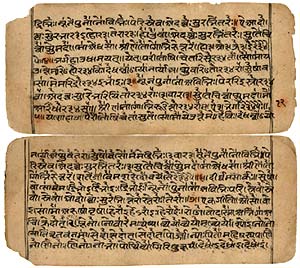
The Sama Veda: An Entry Point and or/Anchor to my Studies of Naad Yoga (The Yoga of Sound) and Sound Therapy Generally


I told myself I would not attend any more schooling for a grip of time after finishing up my studies in massage therapy at the Massage Therapy Institute of Colorado (MTIC) but of course, I was only kidding myself. The very night of graduation, I attended one of a series of classes concerning goddesses of Vedic literature and shortly thereafter, I signed a contract for an introduction course at Shiva Mandir's Center for Vedic Studies.

I wasn't completely sure of what I was doing. I am obviously interested in healing arts. I've completed my massage therapy course and in 2006 I completed a yoga teacher training at Samadhi Center for Yoga. Somewhere in the last little while, I briefly studied with a Barefoot Doctors' Program (with the Tai Chi Project) and I have (hopefully emphatically) communicated my interest in sound therapy studies through The Denver Center for Oriental Medicine. I am very interested in Indian culture and spirituality and have been studying it on my own for years now along with other bits from many cultures, native and far.

I have even more interests than that! These are interests that apparently I cannot or will not give up. I am a singer (who hasn't had a regular gig since 2006 because of school, work and multiple moves but who intends to still write, perform, and seek out music), a writer (who has published in some small publications, print and internet, and who has won some small awards and scholarships), and I have an interest in linguistics, words, communication, and poetry. I began my college career with a full tuition waiver for music (Jazz Studies) and finished my bachelor's degree in writing and linguistics (minor). I did not pursue (though I may pursue it later) an MFA in creative writing because I felt that it would put these interests further on the back burner and of course, most of the MFAs that I could have obtained a teacher's assistanceship and stipend for felt limiting.

It's funny how we come full circle, sometimes. I was interested in music therapy only fleetingly in high school (I thought I was going to become a great jazz singer...and I may still do some of that) and the programs I looked at then (which were sparse) seemed very limited. As you can see, limitation is not okay with me.

The last time I tried to complete a degree in music (probably around 2009), I knew that my goal was to do a final project that involved music and sound therapy. I was very excited about the project and even had a wonderful adviser who lent what became the bulk of a bibliography towards these studies. She also gave me many names, numbers, and resources to this goal. I still have these things and hope that they will contribute to my studies and career (if this is what is indeed occurring, the development of a career) and I have been collecting other names and resources along the way.

So the point of this post? I attended a meditation retreat a few short weeks ago via the Vedic Studies Course mentioned above. I already had come across readings and teachers (such as the Sanskrit for Yogis course created and taught by Dr. Katy Poole) which spoke to the power and resonance contained in Sanskrit (and really, all sound, all language). During the retreat, this information was reiterated but also enhanced by the note that the Sama Veda is a whole book of knowledge about melody or sound. I was excited immediately because here is a study tool that touches on so many of my interests. Further, if I can, studying this portion of the Vedas could provide an anchor and starting point for me to stem off of which does not stray too far away from the studies I have immersed myself in to date. Further, Sama Veda seems to hook together the interests that before seemed so disparate and scattered.

I am not sure if I am taking a course far too overwhelming but I have already sent out a couple of inquiries about the study. My excitement for learning has been renewed and I am more sure of myself that I have chosen the right path for myself, even if the lack of certifications or degrees in certain subjects make me seem subpar, not serious, or simply unworthy of expertise.

Friday, June 22, 2012

Here's Something Fun -- The Copy-Change (or imitation) Poem and a Boff


One of the prompts that keeps coming up in poetry classes is the copy-change, or imitation poem. I've seen the exercise again and again since probably the third grade. Essentially, you choose a poem and use it as the skeleton for a new poem that you create. For more information about this prompt or method, check out this link. 

I generally don't like the exercise (despite its value, which I agree can assist in teaching how poems can work in a bit of a training wheels kind of way). I tend to either make a joke out of the copy-change or redraft the copy change to make my own poem. Tonight I wanted to share one of the jokes and perhaps at another time, I will share one of the redraftings. Below follows my copy change poem from a 2006 poetry class after Robert Frost's The Road Not Taken. I hope the poem evokes a few chuckles. =)


The Pee Not Taken: A Parody that Will
Surely Send Frost to Haunt Me From His Grave

Two seconds before my gates unleash,
And sorry I didn't take a pee
Before my leaving, I clench my teeth
And look down the path far's I can see
Where I might crouch by a bush to pee;

Then hold my nethers, as best I can,
And walking perhaps slowly is best,
Because I'd hate to wet my clutching hands;
Though hands soaked can't match soaking pants
And stained legs, dreading the sodding rest,

Both pants, hands in danger of the leak
Unleashed over leaves finally.
Oh, that I dread my neighbor's toilet seat!
Although my house is just up the street
I doubt I can make it successfully.

My neighbor will remind with a scoff
Someday ages and ages hence:
How I stubbornly ran out and off--
I became the man in this boff,
And sorrowfully ruined my pants.

Tuesday, June 19, 2012

Letting Go and What Serves Us: A Dialogue on the Clarification of Action and Terms

love gun found on Broadway/Denver
photo by Tameca L Coleman.

I need clarification if anyone here is willing to help. I may ask people specifically, via private mail. I may not. I may just continue to read and ruminate on my own, commit these thoughts to my private journals, and forget that I want to talk with others about this very thing. Any comments or feedback is very much appreciated.

I am really confused about all this talk about living in the present moment/letting go of the past because I wonder if sometimes doing that for some people, means not feeling responsible or taking responsibility for the things we may have done in the past that either were not within the guidelines of our own code of ethics or integrity or perhaps those things that hurt others as they were re/actions out of what ails us.

I don't mean to say that we should hold on to those things but we should surely learn from them, take heed of the mistakes so that hopefully they are not done and done again, and forgive ourselves properly instead of just detaching from it all, living in the present moment because the past is already done. . . .

Is this New Age recklessness or irresponsibility under the guise of something better? Certainly, I'm missing something but there just seems to be so much detaching. . . .detaching, detaching, and looking for those things that only serve us (really all of it serves because it's the lessons inherent in all, isn't it (?)) which for some reason feels to me like a sort of numbing where only pleasure is sought. Am I not seeing this correctly? Is my filter off? Seriously, I want to hear others' thoughts about this.

I wonder too, if we're always letting go of people, letting them take care of themselves, even if they do not have the tools because maybe their presence "does not serve us" or doesn't make us happy anymore does more harm than good.

...and then if we don't have the tools to help those who don't have tools. . . . I get that part and don't know what to do about that either. I hope that I can move beyond ignoring those who need a little something more than a snub or cold shoulder.

I see so many people walking around wounded to a point of despair and I know I have been to those points as well and luckily I have had some sort of support to guide me through. Luckily, I had the sense to ask sometimes (not all the time). Not everyone has the support or the sense (and that's not meant to say that they are stupid but that perhaps they are flooded by what ails them and so therefore don't even know if they can ask or how).

I guess I just keep thinking I can do something about it and I keep looking for others who want to do something about it, too. And I am talking about the implementation of tools here, empowerment, not saving, not shouldering the weight of what ails the whole of the wailing parts of the world.

Thursday, May 3, 2012

Arguments for Writing Poetry (1)

I love this quote from Mark Strand's The Weather of Words: 
I is for immortality, which for some poets is a necessary compensation. Presumably miserable in this life, they will be remembered when the rest of us are long forgotten. None of them asks about the quality of that remembrance--what it will be like to crouch in the dim hallways of somebody's mind until the moment of recollection occurs, or to be lifted off suddenly and forever into the pastures of obscurity. Most poets know better than to concern themselves with such things. They know the chances are better than good that their poems will die when they do and never be heard of again, that they'll be replaced by poems sporting a new look in a language more current. They also know that even if individual poems die, though in some cases slowly, poetry will continue: that its subjects, it constant themes, are less liable to change than fashions in language, and that this is where an alternate, less lustrous immortality might be. We all know that a poem can influence other poems, remain alive in them, just as previous poems are alive in it. Could we not say, therefore, that individual poems succeed most by encouraging revisions of themselves and inducing their own erasure? Yes, but is this immortality, or simply a purposeful way of being dead?
The quote makes me happy, giddy, really and it also reminds of the following quote from Ted Kooser's The Poetry Home Repair Manual: 


Considering the ways in which so many of us waste our time, what would be wrong with a world in which everybody were writing poems? After all, there’s a significant service to humanity in spending time doing no harm. While you’re writing your poem, there’s one less scoundrel in the world. And I’d like a world, wouldn’t you, in which people actually took time to think about what they were saying? It would be, I’m certain, a more peaceful, more reasonable place. I don’t think there could ever be too many poets. By writing poetry, even those poems that fail and fail miserably, we honor and affirm life. We say ‘We loved the earth but could not stay.
I like adding to energy, and creating poems to the whole process of creation seems like adding energy to me. Further, all of this rings of some kind of spiritual and moral life. These things are also close to my heart. I live a life of some sort of spiritual discipline, hoping to add to the good in the world.


There are so many arguments that poetry is dead but I don't think that is true. It's not just these quotes that make me think that but the way in which I see poetry working in the communities around me. I see poetry as a healing conduit, a way that people connect, share, vent, transform, understand, make connections and build dialogues. Perhaps what is dead is the ego in poetry. The Poet's work is for all not just for one. I think it's probably always been that way, despite any of our initial hope and search for glory.

Wednesday, May 2, 2012

First Post of Many Poet's Journal Posts

It's time to post regularly.

I thought I would start with some poet's journal posts, most of which will come from a notebook I did for a poetry class in college (2006). I am partially copying my friend John May, whose autodidactic tendencies are both admirable and inspiring. His knowledge, poems, and explications are constantly growing. Please visit his blog. He does good work.

Between the old journal, the inspiration, and of course further readings on my own time, I hope to add to the conversation, or at least post tidbits here for me to revisit as I need or want to or can. Part of this blog then will be a poetry journal that I can access and share online.

I do hope that others will join in the conversation, post their thoughts, write their own posts, share their work, and on and on. I miss the classes, the friends, conversations, and the workshops. Here's hoping I retrieve back some of which I crave.

I wanted to start out with this, a quick essay over the question of whether poetry need be accessible. I would love to hear your thoughts. I see a couple of slippery slopes down there. I didn't edit them out because I'd love to be argued with. ;) Peace and junk:

Accessible Poetry First

"Poetry is knowledge, salvation, power, abandonment. 
The poem is a shell that echoes the music of the world."
--Octavio Paz.

The most potent poetry is universal. It communicates. Its aim is to translate abstractions and the human experience into language. It translates the subconscious, memory, sensual experiences and emotions through images, allusions, and a poet's perception. When a poem is inaccessible, it alienates the reader, guaranteeing a lack of connection between the reader and the poet. There is no communication. Many poets argue that they have a duty to connect with readers. Sylvia Plath for example, states that "one should be able to manipulate [their experiences] with an informed and intelligent mind...personal experience shouldn't be a kind of shut box and mirror-looking narcissistic. ...it should be generally relevant to such things as Hiroshima and Dachau...[things that others can relate to directly or indirectly]" (Alvarez).

Inaccessible poetry can offer grand mind games. It can send readers on scholastic scavenger hunts through dusty library book shelves and obscure articles in databases, as in the case of many of Ezra Pound's or T.S. Eliot's. The readers of such works will surely become smarter and more experienced. However, for those looking to solely connect, inaccessible poetry is a kill shot which can shock a reader from ever trying poetry again. William Carlos Williams states, in his poem "Asphodel, That Greeny Flower," that though "It is difficult/ to get the news from poems/...men die miserably every day/ for lack/ of what is found there."

This statement suggests that poetry is an extremely important medium for the understanding of things that are difficult to talk about or understand. Poetry approaches life's questions and though it does not always succeed in finding answers, it tries. It sends the message that the trying is worth the effort. In Poetry's search for understanding, it dually aids others in their own search as they read. To obscure the message in poems for the sake of being elite is to shirk the Poet's duty and to greedily hoard the message for a select number. It is a tactic that can make the way too difficult for readers uninterested in scholastic exercises. Elitism suggests that one must become a person of letters in order to understand the work. Any reader communing with poetry wants to be touched by it. If it is not understood, it is difficult to feel anything. 


Work Cited: Alvarez, A. Sylvia Plath. Beyond All This Fiddle. London: Penguin, 1968. pp. 56-7.


Sunday, April 8, 2012

Resurrection of Old School Junk as Blog Fodder (!)

For a long time now I have been trying to figure out what to do with the crap ton of files, paperwork, essays and junk that I have accumulated from my undergrad career. Further, I have wanted to utilize my blog more actively to both show that I have done some work and that I intend to continue work as a writer and such.

So, as I go through boxes upon boxes of things, throwing things out and of course organizing the keepers, I'll share what I can and hope for readers and their feedback.

If nothing else, this will be a portfolio, of sorts and a way for me to share some things that I would not otherwise send out to publishers. I would rather not sit on or forget these things. They are easily lost. Further, unearthing them, for me, has been some sort of fun!

Saturday, November 19, 2011

Brand Spankin' New Poem in a Brand Spankin' New Anthology


I have a new poem, written especially for this issue of Cellar Door: An Anthology. I have only scanned part of the poem. To see the rest of it and some other really great writing, art, comics and more, check out Cellar Door's Etsy page. You can also find many wonderful buttons created by local artists. Buttons feature authors, rappers, persons of note and quotes to go along with them. Funds help support the anthology.